
Introduction
Tiles have become an essential part of modern architecture and interior design, offering durability, aesthetics, and versatility for residential, commercial, and industrial spaces. Behind every high-quality ceramic or porcelain tile lies a sophisticated manufacturing process that combines natural resources, advanced technology, and strict quality control measures. From selecting premium raw materials to delivering finished products to global markets, each stage plays a vital role in ensuring superior performance and visual appeal.
Understanding the tile manufacturing journey helps customers, architects, builders, and distributors appreciate the precision and expertise involved in creating world-class tiles. In this blog, we explore every stage of the manufacturing process and demonstrate how Face Impex Pvt Ltd maintains exceptional standards to produce premium ceramic and porcelain tiles for customers worldwide.
1. Introduction to Tile Manufacturing
Tile manufacturing is a carefully controlled process that transforms natural minerals into durable and aesthetically appealing products used in homes, offices, hotels, and commercial projects. Modern tile production combines traditional ceramic expertise with advanced automation and digital technology to create products that meet international quality standards.
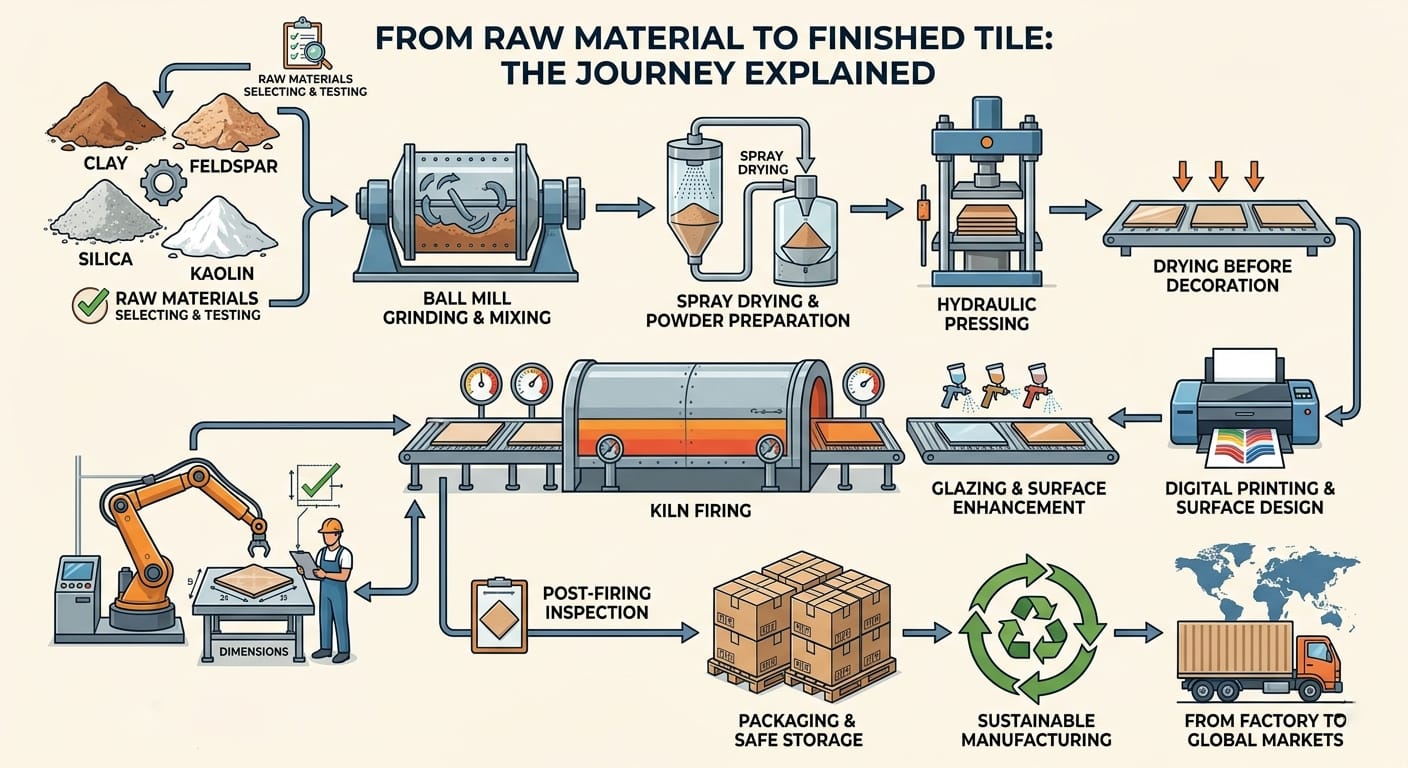
The journey begins with the selection of raw materials and continues through multiple stages such as grinding, pressing, drying, decoration, glazing, firing, and quality inspection. Every step is designed to improve the tile’s strength, durability, water resistance, and appearance. Today’s manufacturers utilize sophisticated machinery and computerized systems to ensure consistency and precision throughout production.
As global demand for premium ceramic and porcelain tiles continues to rise, manufacturers focus on innovation, sustainability, and quality assurance. Understanding this process helps customers appreciate the craftsmanship and engineering that go into creating high-performance tiles suitable for modern architectural applications.
2. Selection of Raw Materials
The foundation of every high-quality tile begins with carefully selected raw materials. The most important ingredients used in tile manufacturing include clay, feldspar, silica, kaolin, and various natural minerals. Each material contributes specific properties that affect the tile’s strength, durability, texture, and overall performance.
Clay provides plasticity and helps form the tile shape, while feldspar acts as a flux that promotes vitrification during firing. Silica contributes hardness and dimensional stability, ensuring the finished tile remains strong and resistant to wear. Additional minerals may be added depending on the desired tile characteristics and design requirements.
Manufacturers carefully source raw materials from reliable suppliers and conduct extensive evaluations before production begins. The quality of these materials directly impacts the final product’s performance. By selecting premium-grade minerals, manufacturers ensure the production of tiles that meet international standards for durability, aesthetics, and long-term reliability.
3. Raw Material Testing and Quality Control
Before entering the production line, all raw materials undergo rigorous testing and quality control procedures. This stage is essential because even minor variations in material composition can affect the performance and appearance of finished tiles.
Manufacturers analyse physical and chemical properties such as moisture content, particle size distribution, mineral composition, plasticity, and impurity levels. Advanced laboratory equipment helps technicians verify consistency and compliance with production specifications. These tests ensure that raw materials meet strict quality standards before being approved for manufacturing.
Effective quality control minimizes production defects, improves efficiency, and ensures uniformity throughout the manufacturing process. Consistent raw materials contribute to better tile strength, accurate dimensions, superior surface finishes, and reliable performance. By maintaining strict testing protocols, manufacturers can deliver premium products that meet customer expectations and international certification requirements.
4. Grinding and Mixing Process
After approval, raw materials are transferred to grinding and mixing systems where they are transformed into a fine and homogeneous mixture. This stage is critical because uniform particle size and composition directly influence the quality of the finished tile.
Advanced ball mills and grinding equipment reduce raw materials into microscopic particles, ensuring consistency throughout the mixture. Water is added to create a slurry that allows the ingredients to blend thoroughly. Computerized controls monitor the process to maintain precise proportions and achieve optimal material characteristics.
A well-prepared mixture improves pressing efficiency, firing performance, and overall product quality. It also reduces defects such as warping, cracking, and uneven surfaces. By utilizing modern grinding technologies and automated controls, manufacturers create a highly consistent base material that forms the foundation for strong, durable, and visually appealing ceramic and porcelain tiles.
5. Spray Drying and Powder Preparation
Once the slurry is prepared, it moves to the spray drying stage, where moisture content is carefully controlled to produce granulated powder suitable for tile formation. This process plays a crucial role in ensuring consistent density and strength during pressing.
In spray dryers, the slurry is atomized into fine droplets and exposed to hot air. The water evaporates rapidly, leaving behind uniform granules with controlled moisture levels. These granules possess excellent flow characteristics and compressibility, making them ideal for hydraulic pressing.
Proper powder preparation ensures uniform tile density, minimizes defects, and improves production efficiency. Consistency at this stage directly impacts dimensional accuracy, surface quality, and structural integrity. Modern spray drying systems allow manufacturers to maintain strict control over particle size and moisture content, contributing significantly to the production of premium-quality ceramic and porcelain tiles.
6. Tile Forming and Hydraulic Pressing
Hydraulic pressing is one of the most important stages in tile manufacturing. During this process, prepared powder is placed into specially designed moulds and compressed under extremely high pressure to create the desired tile shape and dimensions.
Modern hydraulic presses generate tremendous force, ensuring uniform density throughout the tile body. This results in improved strength, dimensional accuracy, and resistance to breakage. Computer-controlled systems monitor pressure levels and production parameters to maintain consistency across every tile produced.
Accurate pressing is essential for achieving smooth surfaces, sharp edges, and precise dimensions. It also minimizes internal stress that could lead to defects during firing. Through advanced pressing
technology, manufacturers produce tiles capable of meeting demanding architectural and commercial requirements while maintaining exceptional quality standards.
7. Drying Process Before Decoration
After pressing, newly formed tiles still contain residual moisture that must be removed before decoration and glazing. Controlled drying prevents structural damage and prepares tiles for subsequent manufacturing stages.
Specialized dryers gradually reduce moisture levels while maintaining dimensional stability. Careful temperature and humidity control help prevent issues such as cracking, warping, or distortion. Uniform drying ensures that every tile maintains its intended shape and size throughout production.
This stage is essential because excess moisture can negatively affect digital printing, glazing, and firing performance. By ensuring optimal moisture content, manufacturers improve product quality, reduce waste, and enhance overall production efficiency. Proper drying contributes significantly to the production of durable and visually appealing tiles.
8. Digital Printing and Surface Design
Modern digital printing technology has revolutionized tile design by allowing manufacturers to create highly realistic and detailed surface patterns. Advanced inkjet printers reproduce the appearance of natural stone, marble, wood, concrete, and decorative textures with remarkable precision.
High-resolution printing systems apply specialized ceramic inks directly onto tile surfaces. Multiple layers of design can be combined to achieve depth, texture, and visual realism. This technology enables virtually unlimited design possibilities while maintaining consistency across large production volumes.
Digital printing enhances creativity and allows manufacturers to respond quickly to changing market trends. Customers benefit from a wider selection of sophisticated designs that combine aesthetic appeal with the durability and practicality of ceramic and porcelain tiles.
9. Glazing and Surface Enhancement
Glazing provides both protection and aesthetic enhancement to ceramic and porcelain tiles. Specialized glaze formulations are applied to the tile surface to create different finishes, including glossy, matte, satin, textured, and anti-slip effects.
The glaze layer improves stain resistance, chemical resistance, scratch resistance, and ease of maintenance. It also enhances colour vibrancy and contributes to the overall visual appeal of the finished product. Advanced application systems ensure uniform coverage and consistent surface quality.
Manufacturers carefully select glaze compositions based on intended applications and design requirements. Through innovative glazing technologies, tiles achieve superior performance characteristics while maintaining attractive finishes suitable for residential and commercial environments.
10. Kiln Firing: Transforming Tiles Through Heat
Kiln firing is the stage where pressed and decorated tiles are transformed into strong, durable, and fully finished products. During this process, tiles are exposed to extremely high temperatures, often ranging between 1,000°C and 1,250°C, depending on the tile type and manufacturing requirements. The intense heat causes physical and chemical changes within the tile body, resulting in vitrification, increased density, and enhanced durability.
Modern roller kilns are equipped with advanced temperature control systems that ensure consistent heating and cooling throughout the firing cycle. This precision minimizes defects such as warping, cracking, and colour variations while ensuring uniform quality across every batch. The firing process also permanently fuses glazes and decorative designs onto the tile surface. As a result, tiles achieve their final strength, water resistance, hardness, and aesthetic appeal, making them suitable for demanding residential and commercial applications.
11. Post-Firing Inspection and Quality Checks
Once tiles have completed the firing process, they undergo comprehensive inspection and quality testing to ensure they meet strict industry standards. This stage is critical because even minor imperfections can affect performance, appearance, and customer satisfaction. Manufacturers utilize advanced testing equipment and experienced quality control teams to evaluate every aspect of the finished product.
Tiles are inspected for dimensions, thickness consistency, surface finish, edge quality, colour uniformity, and structural integrity. Additional tests may include water absorption analysis, breaking strength evaluation, abrasion resistance, stain resistance, and chemical resistance testing. Automated vision systems can identify even the smallest surface defects that might not be visible to the naked eye.
Through rigorous quality assurance procedures, manufacturers ensure that only products meeting established specifications reach the market. This commitment to excellence guarantees reliable performance, durability, and customer confidence in every tile produced.
12. Cutting, Rectification, and Finishing
After quality inspection, tiles may undergo additional finishing processes to enhance precision and improve installation performance. Cutting, rectification, and edge finishing are essential procedures that ensure tiles meet exact dimensional requirements and achieve a premium appearance. These processes are particularly important for large-format and high-end porcelain tiles used in modern architectural projects.
Rectification involves grinding tile edges with diamond tools to achieve perfectly straight and uniform dimensions. This allows installers to use minimal grout joints, creating a sleek and contemporary look. Additional finishing techniques may include polishing, lapping, texturing, or surface treatments designed to enhance visual appeal and functional performance.
Precision finishing improves installation accuracy, aesthetic consistency, and overall customer satisfaction. By utilizing advanced machinery and strict quality controls, manufacturers deliver tiles with exceptional dimensional accuracy and refined finishes suitable for luxury residential and commercial environments.
13. Packaging and Safe Storage
Proper packaging and storage play a crucial role in maintaining tile quality after production. Even the highest-quality tiles require effective protection during handling, transportation, and warehousing to ensure they reach customers in perfect condition. Manufacturers invest in advanced packaging systems designed to prevent damage and preserve product integrity throughout the supply chain.
Tiles are carefully sorted, counted, and packed into durable cartons with protective separators and cushioning materials. Product labels include important information such as size, batch number, shade variation, and technical specifications, enabling accurate inventory management and traceability. Palletization techniques further improve transportation efficiency and reduce the risk of breakage.
Safe storage practices include climate-controlled warehouses, organized inventory systems, and secure stacking procedures. By implementing comprehensive packaging and storage standards, manufacturers ensure that their products maintain their appearance, quality, and performance from the factory floor to the final installation site.
14. Sustainable Manufacturing Practices
Sustainability has become a major focus within the ceramic and porcelain tile industry as manufacturers strive to reduce environmental impact while maintaining high production standards. Modern tile manufacturing incorporates eco-friendly technologies and responsible resource management practices that support long-term environmental goals and operational efficiency.
Many manufacturers utilize energy-efficient kilns, water recycling systems, and advanced waste management processes to minimize resource consumption. Recovered materials and production waste are often reintroduced into the manufacturing cycle, reducing landfill contributions and conserving raw materials. Solar energy systems and emission control technologies further support sustainable production initiatives.
Sustainable manufacturing not only benefits the environment but also improves operational performance and customer confidence. By embracing green technologies and environmentally responsible practices, tile manufacturers contribute to global sustainability efforts while delivering high-quality products that meet the expectations of environmentally conscious customers and construction professionals.
15. From Factory to Global Markets
The journey of a tile does not end at manufacturing; it continues through a complex distribution and logistics network that delivers products to customers around the world. Global tile exports require careful planning, efficient transportation systems, and strict compliance with international trade regulations to ensure timely and secure deliveries.
Manufacturers coordinate packaging, warehousing, container loading, customs documentation, and freight management to facilitate smooth international shipments. Strong partnerships with logistics providers and distribution networks help ensure products reach wholesalers, retailers, architects, and project developers efficiently. Export-focused companies also adapt their products to meet specific regional standards and customer preferences.
As demand for premium ceramic and porcelain tiles grows globally, efficient supply chain management becomes increasingly important. A well-organized export infrastructure enables manufacturers to expand market reach, strengthen customer relationships, and deliver high-quality tile solutions to diverse international markets.
16. Face Impex Pvt Ltd.’s Commitment to Quality
At Face Impex Pvt Ltd, quality is not simply a production objective – it is a core business philosophy that guides every stage of manufacturing and customer service. The company follows stringent quality control procedures to ensure that every tile meets international standards for durability, aesthetics, and performance. From raw material selection to final packaging, each process is carefully monitored and optimized.
Advanced testing methods, experienced quality specialists, and modern production technologies work together to maintain consistency across product lines. Every batch undergoes detailed inspection to verify dimensions, surface quality, strength, and overall reliability before reaching customers. This proactive approach helps minimize defects and maximize customer satisfaction.
By maintaining uncompromising quality standards, Face Impex Pvt Ltd has established a reputation for delivering dependable ceramic and porcelain tile solutions that meet the requirements of distributors, architects, builders, and homeowners worldwide.
17. Innovation and Advanced Manufacturing at Face Impex Pvt Ltd
Innovation is a driving force behind the continued success of Face Impex Pvt Ltd in the competitive global tile industry. The company continuously invests in modern manufacturing technologies, automation systems, and research-driven production techniques to deliver products that combine superior performance with contemporary design trends.
Advanced machinery enables precise material preparation, high-pressure pressing, digital decoration, and controlled firing processes. State-of-the-art digital printing technology allows the creation of realistic marble, stone, wood, and decorative surfaces that appeal to modern architectural preferences. Continuous process improvements help increase production efficiency while maintaining strict quality standards.
The company’s commitment to innovation extends beyond manufacturing and includes product development, sustainability initiatives, and customer-focused solutions. By embracing technological advancements and industry best practices, Face Impex Pvt Ltd consistently produces premium ceramic and porcelain tiles that meet the evolving needs of international markets.
18. Why Choose Face Impex Pvt Ltd for Global Tile Solutions
Face Impex Pvt Ltd has emerged as a trusted partner for customers seeking premium ceramic and porcelain tile solutions for residential, commercial, and large-scale construction projects. The company combines manufacturing expertise, advanced technology, quality assurance, and global market experience to deliver exceptional value to customers worldwide.
A diverse product portfolio allows clients to choose from a wide range of designs, finishes, sizes, and applications. Strong export capabilities, reliable logistics support, and responsive customer service ensure smooth business operations and timely deliveries across international markets. The company’s focus on innovation and continuous improvement helps it remain competitive in a rapidly evolving industry.
By prioritizing quality, consistency, customer satisfaction, and long-term partnerships, Face Impex Pvt Ltd continues to strengthen its position as a reliable global tile supplier. Customers can confidently choose the company for durable, stylish, and high-performance tile solutions tailored to modern architectural demands.
Conclusion
The journey from raw material to finished tile is a remarkable process that combines natural resources, advanced engineering, precision manufacturing, and rigorous quality control. Every stage, from raw material selection and testing to digital decoration, kiln firing, inspection, and global distribution, contributes to creating tiles that offer exceptional durability, beauty, and performance.
At Face Impex Pvt Ltd, quality, innovation, and customer satisfaction remain at the core of every manufacturing operation. By utilizing modern technology, sustainable practices, and strict quality standards, the company delivers premium ceramic and porcelain tile solutions to customers across international markets.
Whether for residential, commercial, or large-scale architectural projects, Face Impex Pvt Ltd continues to provide world-class tile products that combine style, reliability, and long-lasting value.