
Introduction
High-quality tiles are not just a design element; they are the result of precise engineering, advanced technology, and carefully controlled manufacturing processes. In modern construction, tiles play a crucial role in defining durability, aesthetics, and long-term performance of residential and commercial spaces. The journey from raw minerals to finished tiles involves multiple scientific and mechanical stages that ensure strength, beauty, and consistency in every piece. Understanding this manufacturing process helps architects, builders, and customers make informed decisions while selecting the right tiles. From raw material selection to final packaging, every step is essential in creating premium-quality tiles that meet international standards. This blog takes you behind the scenes to explore how high-quality tiles are manufactured with precision, innovation, and excellence in the ceramic industry.
1. Introduction: The Science Behind Quality Tiles
Tile manufacturing is a blend of science, engineering, and creativity that ensures both functionality and visual appeal. In the construction industry, tiles are essential for flooring, wall cladding, and exterior applications due to their strength and versatility. The quality of tiles directly influences durability, maintenance, and overall aesthetics of a space. Advanced manufacturing techniques help achieve uniformity, strength, and design precision in every tile. Modern production facilities use controlled environments and automated systems to maintain consistency. Each stage of production is carefully monitored to eliminate defects and enhance performance. High-quality tiles are not just decorative elements but long-term investments that add value to properties. Understanding this scientific process highlights why premium tiles stand out in terms of durability, performance, and visual excellence.
2. Selection of Premium Raw Materials
The foundation of high-quality tiles begins with the selection of premium raw materials. Essential components like clay, feldspar, silica, and natural minerals are carefully chosen based on their purity and chemical composition. These materials determine the final strength, texture, and appearance of the tiles. High-grade raw materials ensure low water absorption, improved durability, and better resistance to wear and tear. Manufacturers source these materials from reliable suppliers to maintain consistency in production. Any impurity in raw materials can affect the final product quality, making selection a critical stage. The right balance of minerals is essential to achieve the desired physical and mechanical properties. By using superior raw materials, manufacturers can produce tiles that meet international standards and perform exceptionally well in both residential and commercial environments.
3. Raw Material Processing and Preparation
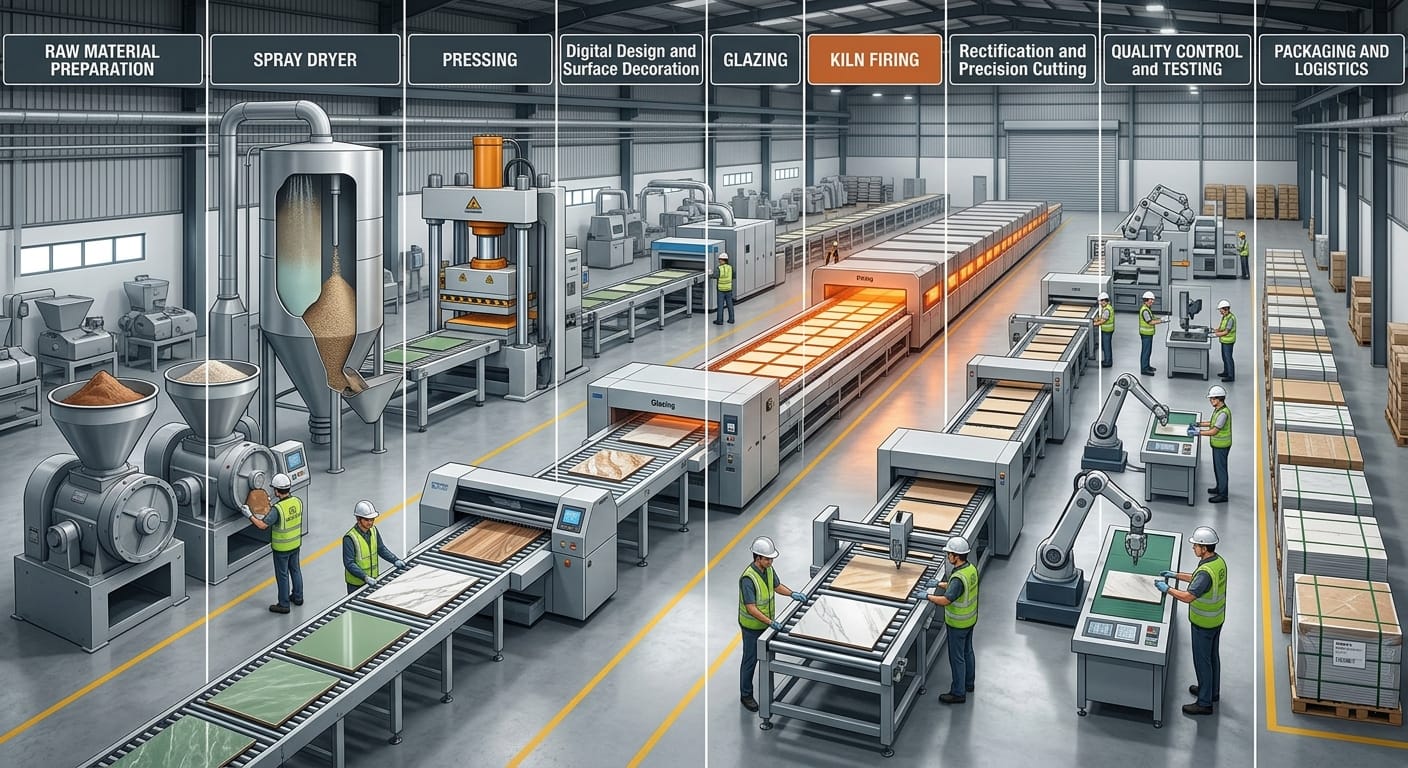
Once raw materials are selected, they undergo a detailed processing and preparation stage. This includes crushing, grinding, and mixing to achieve a fine and uniform composition. Large mineral chunks are broken down into smaller particles using advanced machinery, ensuring consistency in texture. The grinding process refines the materials into a fine powder, which is then blended in precise proportions. This step is crucial because uniformity in composition directly impacts tile strength and finish. Automated systems are used to maintain accuracy and reduce human error. Proper mixing ensures that all minerals bond effectively during firing. The prepared mixture forms the base for all subsequent manufacturing stages. This controlled preparation process guarantees that the tiles produced are strong, durable, and free from structural inconsistencies.
4. Spray Drying: Creating the Ideal Tile Body
Spray drying is a vital stage in tile manufacturing where liquid slurry is transformed into fine granules. The slurry, made from mixed raw materials, is sprayed into a high-temperature chamber where moisture evaporates instantly. This process results in uniform powder granules with controlled moisture content. Maintaining the right level of moisture is essential for achieving optimal tile formation during pressing. Spray drying ensures consistency in particle size, which improves the compaction and density of tiles. This stage also enhances workability and reduces defects during shaping. The resulting granulated powder is ideal for high-pressure pressing, ensuring smooth production flow. Spray drying plays a key role in maintaining product uniformity and is a critical step in producing high-quality ceramic and porcelain tiles used in modern architecture.
5. High-Pressure Tile Pressing
High-pressure pressing is the stage where tiles begin to take their final shape. The prepared granules are placed into advanced hydraulic presses that apply extreme pressure to form dense and uniform tiles. This process ensures that each tile has consistent thickness, size, and structural strength. High pressure eliminates air gaps, resulting in compact and durable tile bodies. Automated pressing machines allow precise control over dimensions and density. This stage is crucial for achieving tiles that can withstand heavy loads and long-term usage. The uniformity achieved during pressing directly impacts the tile’s performance in flooring and wall applications. By using modern pressing technology, manufacturers ensure high strength, low porosity, and superior durability in every tile produced.
6. Drying Process: Preparing Tiles for Production
After pressing, tiles contain residual moisture that must be carefully removed before firing. The drying process ensures that tiles are free from excess water, which could cause cracks or deformation during kiln firing. Controlled drying chambers are used to gradually reduce moisture levels while maintaining structural integrity. Rapid or uneven drying can lead to defects, so temperature and humidity are strictly regulated. This stage enhances the stability of tiles and prepares them for high-temperature processing. Proper drying also improves bonding between particles, resulting in stronger finished products. It is a critical step in preventing warping and ensuring dimensional accuracy. By carefully managing this process, manufacturers achieve high-quality tiles with excellent durability and consistent performance.
7. Digital Design and Surface Decoration
Modern tile manufacturing incorporates advanced digital printing technology to create visually stunning designs. This stage allows manufacturers to replicate natural materials like marble, wood, and stone with incredible realism. High-resolution digital printers apply intricate patterns and textures directly onto the tile surface. This technology offers limitless customization options for residential and commercial projects. It ensures colour consistency, sharp detailing, and long-lasting designs that do not fade easily. Digital decoration also enhances creativity, allowing unique patterns tailored to customer preferences. The precision of this technology makes tiles more appealing and versatile for modern interiors. With digital design, manufacturers can combine aesthetics with functionality, producing tiles that meet both architectural and decorative requirements.
8. Glazing Technology and Surface Enhancement
Glazing is a protective and decorative layer applied to tile surfaces to enhance their appearance and durability. This process involves coating tiles with a special glaze material that is later fused during firing. Glazing provides a glossy or matte finish depending on design requirements. It improves resistance to stains, scratches, and moisture, making tiles more durable and easier to maintain. The glaze also enhances colour vibrancy and adds depth to surface patterns. Advanced glazing techniques allow precise control over texture and finish. This stage is essential for creating premium-quality tiles suitable for both indoor and outdoor applications. By combining aesthetics with protection, glazing significantly increases the lifespan and performance of tiles.
9. High-Temperature Kiln Firing
Kiln firing is one of the most critical stages in tile manufacturing, where raw materials are transformed into solid ceramic products. Tiles are exposed to extremely high temperatures in controlled kilns, causing chemical and physical changes that enhance strength and durability. This process permanently bonds the materials, creating a hard and stable structure. The firing temperature and duration are carefully controlled to ensure uniform quality. Proper kiln firing improves resistance to wear, water absorption, and thermal stress. It also determines the final color and texture of tiles. Advanced kiln systems ensure energy efficiency and consistent results. This transformation stage is essential in producing high-performance tiles suitable for demanding environments.
10. Quality Control Throughout Manufacturing
Quality control is integrated into every stage of tile manufacturing to ensure consistency and reliability. From raw material inspection to final packaging, each process is closely monitored. Automated systems and expert technicians conduct regular checks to identify defects and maintain standards. Parameters such as size, strength, color, and surface finish are evaluated continuously. Any deviation is corrected immediately to avoid production issues. This strict monitoring ensures that only premium-quality tiles reach the final stage. Quality control also helps in maintaining uniformity across large production batches. By implementing rigorous inspection processes, manufacturers guarantee durability, aesthetic excellence, and performance reliability in every tile produced.
11. Rectification and Precision Cutting
Rectification is the process of cutting tiles to precise dimensions after firing. This ensures perfectly straight edges and uniform sizes, which are essential for seamless installation. Advanced cutting machines are used to achieve high accuracy and smooth finishes. Rectified tiles allow minimal grout lines, creating a modern and elegant appearance in flooring and wall applications. This process enhances the visual appeal and installation quality of tiles. Precision cutting also ensures compatibility with large-format designs. By maintaining strict dimensional accuracy, manufacturers improve both functionality and aesthetics. Rectification is especially important for premium tile collections used in luxury and commercial projects.
12. Testing for Durability and Performance
Before reaching the market, tiles undergo rigorous testing to ensure durability and performance standards. Tests include water absorption, scratch resistance, breaking strength, and load-bearing capacity. These evaluations help determine how tiles will perform under real-world conditions. International standards and certifications guide the testing process to ensure global quality compliance. Tiles are also tested for thermal resistance and chemical durability. This ensures they can withstand different environmental conditions without damage. Only tiles that pass all tests are approved for distribution. These quality checks guarantee long-lasting performance and reliability in various applications.
13. Packaging and Safe Transportation
Proper packaging is essential to protect tiles during transportation and storage. High-quality materials such as reinforced cartons, protective foam, and shrink wraps are used to prevent damage. Tiles are carefully stacked and secured to avoid breakage. Each package is labeled for easy identification and handling. Efficient logistics systems ensure safe delivery to domestic and international markets. Packaging also plays a role in maintaining product quality until installation. By using advanced packaging techniques, manufacturers ensure that tiles reach customers in perfect condition, ready for use without defects.
14. Sustainable Manufacturing Practices
Modern tile manufacturing emphasizes sustainability and environmental responsibility. Energy-efficient technologies are used to reduce fuel consumption and emissions. Water recycling systems help minimize waste and promote resource conservation. Eco-friendly raw materials and production methods reduce environmental impact. Manufacturers also implement waste management systems to reuse production by-products. Sustainable practices not only protect the environment but also improve operational efficiency. These initiatives align with global green building standards. By adopting eco-friendly manufacturing, the tile industry contributes to a cleaner and more sustainable future.
15. Why Manufacturing Excellence Matters for Customers
Manufacturing excellence directly impacts the value and performance of tiles for customers. High-quality production ensures durability, low maintenance, and long-lasting beauty. Well-manufactured tiles enhance the aesthetic appeal of residential and commercial spaces. They also provide better resistance to wear, stains, and environmental factors. Customers benefit from long-term cost savings due to reduced replacement and maintenance needs. Superior manufacturing processes guarantee consistency in design and performance. Ultimately, excellence in manufacturing translates into higher customer satisfaction and better return on investment.
16. Face Impex Pvt Ltd: Delivering Excellence in Tile Solutions
Face Impex Pvt Ltd is committed to delivering premium-quality ceramic and porcelain tile solutions that meet global standards. The company focuses on innovation, advanced technology, and modern design trends to serve both domestic and international markets. With a strong emphasis on quality and customer satisfaction, it ensures that every product reflects durability and aesthetic excellence. Face Impex Pvt Ltd continuously invests in improving manufacturing processes and design capabilities. Its wide product range caters to residential, commercial, and industrial applications. The company’s dedication to excellence makes it a trusted name in the tile industry.
17. Advanced Quality Standards at Face Impex Pvt Ltd
Face Impex Pvt Ltd follows strict quality control systems to ensure every tile meets international standards. Each production stage is carefully monitored, from raw material selection to final inspection. Advanced testing methods are used to evaluate strength, durability, and finish quality. The company ensures consistency across all batches, maintaining high reliability. Continuous improvement processes help enhance product performance and innovation. These strict quality standards ensure that customers receive only the best products suitable for global markets. The company’s commitment to excellence strengthens its reputation in the tile manufacturing industry.
18. Why Customers Choose Face Impex Pvt Ltd
Face Impex Pvt Ltd is preferred by customers due to its wide range of modern designs, reliable export capabilities, and professional service approach. The company offers tiles that combine aesthetics with long-lasting durability, making them ideal for diverse projects. Its strong logistics network ensures timely delivery across global markets. Customers trust the brand for consistent quality and innovative design solutions. The company’s customer-centric approach and technical expertise make it a reliable partner for architects, builders, and distributors. Its reputation for excellence continues to grow in the international tile industry.
Conclusion
The journey of tile manufacturing is a highly detailed and scientific process that combines advanced technology, skilled craftsmanship, and strict quality control. From selecting raw materials to final packaging, each stage plays a vital role in ensuring durability, strength, and aesthetic appeal. High-quality tiles are not just construction materials but long-term investments that enhance the beauty and value of any space. Understanding this behind-the-scenes process helps customers appreciate the precision and effort involved in creating premium tiles. Companies like Face Impex Pvt Ltd continue to set benchmarks in the industry by delivering innovative and reliable tile solutions. As demand for high-performance tiles grows, manufacturing excellence remains the key to meeting global standards and customer expectations.