
Introduction:
The tile manufacturing industry has undergone a massive transformation over the past few decades. What was once a labour-intensive and time-consuming process has now evolved into a highly advanced, technology-driven industry. At Face Impex Pvt Ltd, innovation and precision are at the core of delivering premium-quality tiles to global markets. Advanced technologies not only improve production efficiency but also enhance design possibilities, durability, and sustainability. This complete guide explores the key technological advancements that are redefining tile production and setting new benchmarks in quality and performance.
1. Introduction to Modern Tile Manufacturing Technologies:
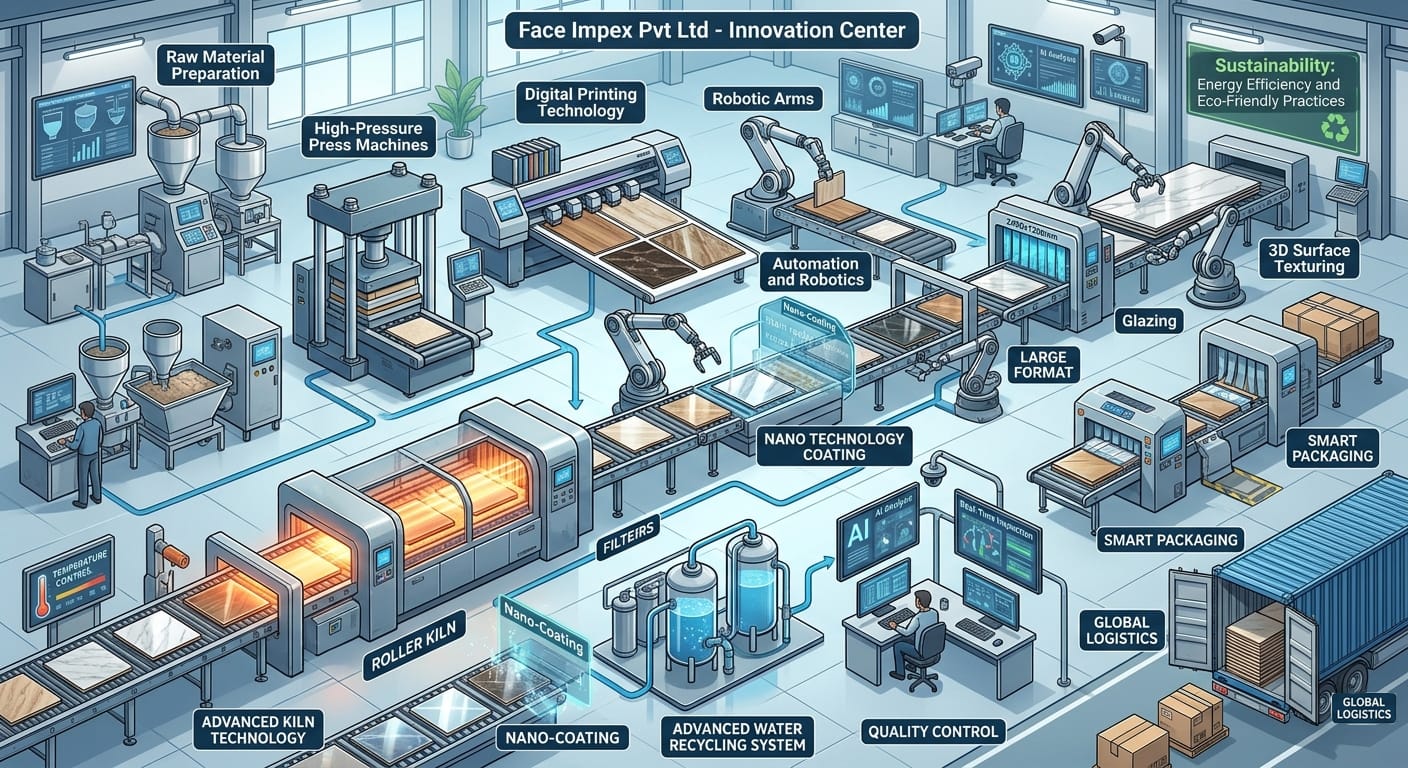
Modern tile manufacturing technologies have revolutionized the entire production process, shifting it from traditional craftsmanship to a highly automated and efficient system. Today’s manufacturing units are equipped with state-of-the-art machinery, computer-controlled systems, and integrated production lines that ensure precision at every stage. From raw material preparation to final packaging, each step is optimized for speed, consistency, and quality.
The introduction of advanced technologies has significantly reduced human dependency, minimizing errors and ensuring uniformity in every tile produced. Manufacturers can now produce large volumes of tiles without compromising on quality, making it easier to meet global demand. Moreover, these technologies allow for better resource utilization, reducing waste and improving overall efficiency. The integration of data-driven systems also helps monitor performance in real-time, enabling quick adjustments and maintaining high production standards.
2. Digital Printing Technology in Tiles:
Digital printing technology has completely transformed tile design and aesthetics. Unlike traditional printing methods, digital printing uses high-definition inkjet technology to create incredibly realistic patterns and textures. This advancement allows tiles to replicate the natural beauty of materials like marble, wood, stone, and even fabric with remarkable accuracy.
One of the biggest advantages of digital printing is its flexibility. Manufacturers can easily change designs without altering the production setup, making it ideal for customization and trend adaptation. It also enables the creation of intricate patterns, gradients, and unique visual effects that were previously impossible. Additionally, digital printing ensures consistency across large batches, maintaining uniformity in colour and design.
This technology not only enhances the visual appeal of tiles but also opens up endless possibilities for interior and exterior design. It allows designers and architects to experiment with creative concepts while maintaining cost efficiency and production speed.
3. Automation and Robotics in Tile Production:
Automation and robotics play a crucial role in modern tile manufacturing by improving efficiency, precision, and safety. Robotic systems are used for various processes such as material handling, cutting, sorting, and packaging. These machines operate with high accuracy and speed, significantly reducing production time.
The use of automation minimizes human intervention, which reduces the chances of errors and inconsistencies. It also enhances workplace safety by handling heavy and repetitive tasks that could pose risks to workers. Furthermore, automated systems can operate continuously without fatigue, ensuring uninterrupted production and higher output.
Robotics also enables better quality control by maintaining uniformity in every tile. With programmable controls, manufacturers can achieve precise measurements and consistent finishes. This level of precision is essential for meeting international quality standards and customer expectations.
4. Advanced Kiln Technology for Better Durability:
Kilns are one of the most critical components in tile manufacturing, and advancements in kiln technology have greatly improved tile quality and durability. Modern kilns are designed with advanced temperature control systems that ensure uniform heat distribution throughout the firing process.
These kilns operate at optimal temperatures, which helps in achieving the desired hardness, strength, and finish of tiles. The precise control over firing conditions reduces defects such as cracks, warping, or uneven surfaces. Additionally, advanced kilns are energy-efficient, consuming less fuel while delivering better results.
Another important aspect is the speed of firing cycles. Modern kilns can process tiles faster without compromising quality, increasing overall production efficiency. The combination of durability, energy efficiency, and precision makes advanced kiln technology a cornerstone of modern tile manufacturing.
5. Nano Technology Coatings in Tiles:
Nano technology has introduced a new level of functionality and performance in tiles. Nano-coatings are applied to tile surfaces to enhance their properties, making them more resistant to stains, bacteria, and moisture. These coatings create a protective layer that prevents dirt and liquids from penetrating the surface.
Tiles with Nano-coatings are easier to clean and maintain, making them ideal for residential and commercial spaces. They also offer antibacterial properties, which are especially beneficial for environments like kitchens, hospitals, and bathrooms. Additionally, Nano technology improves the longevity of tiles by protecting them from wear and tear.
This innovation not only enhances the usability of tiles but also adds value by combining aesthetics with advanced functionality. It reflects the growing demand for smart and hygienic building materials.
6. Sustainability and Eco-Friendly Manufacturing Processes:
Sustainability has become a key focus in modern tile production, and advanced technologies are playing a significant role in achieving eco-friendly manufacturing. Manufacturers are adopting energy-efficient machinery, reducing emissions, and optimizing resource usage to minimize environmental impact.
Advanced production systems help in reducing waste by recycling materials and reusing by-products. The use of renewable energy sources and low-emission technologies further contributes to a greener production process. Additionally, eco-friendly tiles are designed to have a longer lifespan, reducing the need for frequent replacements.
By integrating sustainable practices, companies like Face Impex Pvt Ltd are not only meeting regulatory requirements but also contributing to environmental conservation. This approach aligns with the global shift towards responsible and sustainable construction.
7. Water Recycling Systems in Tile Factories:
Water is an essential resource in tile manufacturing, and modern factories are implementing advanced water recycling systems to reduce consumption. These systems collect, treat, and reuse water used during production processes such as cutting, polishing, and cleaning.
Recycling water not only conserves natural resources but also reduces operational costs. It helps in minimizing wastewater discharge, thereby lowering environmental impact. Advanced filtration and treatment technologies ensure that recycled water meets quality standards for reuse.
This approach demonstrates a commitment to sustainable manufacturing and responsible resource management. It also supports compliance with environmental regulations and enhances the overall efficiency of production processes.
8. High-Pressure Press Machines for Tile Strength:
High-pressure hydraulic press machines are essential for achieving the strength and durability of tiles. These machines apply immense pressure to raw materials, compressing them into dense and uniform shapes. The result is a tile with high mechanical strength and resistance to wear.
The use of advanced press machines ensures consistent thickness and surface quality, which is crucial for both aesthetics and performance. It also reduces the chances of defects such as cracks or uneven surfaces.
These machines are capable of handling large-scale production while maintaining precision and quality. Their role in enhancing the structural integrity of tiles makes them a vital component of modern manufacturing.
9. 3D Surface Technology and Textured Finishes:
3D surface technology has added a new dimension to tile design by creating realistic textures and patterns. This technology allows tiles to mimic the feel of natural materials such as wood grains, stone surfaces, and fabric textures.
The combination of digital printing and 3D texturing results in visually stunning and tactile surfaces. These tiles not only look realistic but also provide a unique sensory experience. They are widely used in premium interior and exterior designs to create a sophisticated and natural ambiance.
This innovation enhances the aesthetic appeal of tiles while offering designers greater creative freedom.
10. Quality Control through AI and Sensors:
Artificial intelligence and smart sensors are transforming quality control in tile manufacturing. These technologies monitor production processes in real-time, detecting defects such as cracks, colour variations, or surface irregularities.
AI systems analyse data to identify patterns and predict potential issues, allowing manufacturers to take corrective actions before defects occur. This proactive approach ensures consistent quality and reduces wastage.
The use of sensors also enables precise measurement and inspection, maintaining high standards throughout the production cycle. This level of quality control is essential for meeting international market requirements.
11. Large Format Tile Production Technology:
The demand for large format tiles has increased significantly, and advanced technology has made their production possible. Modern machinery is capable of producing large slabs with high precision and minimal defects.
These tiles offer a seamless and elegant look, making them popular in modern architecture. However, manufacturing large tiles requires advanced handling systems and precise control to prevent breakage.
Innovations in this area have enabled manufacturers to produce large tiles efficiently, expanding design possibilities and meeting market demand.
12. Glazing Technology Advancements:
Glazing technology has evolved to offer a wide range of finishes, including glossy, matte, satin, and textured surfaces. Advanced glazing techniques enhance the visual appeal and durability of tiles.
Modern glazing systems ensure even application and strong adhesion, resulting in a smooth and long-lasting finish. They also improve resistance to stains, scratches, and fading.
This advancement allows manufacturers to cater to diverse design preferences while maintaining high performance standards.
13. Smart Packaging and Logistics Systems:
Efficient packaging and logistics are essential for delivering tiles safely to global markets. Advanced packaging systems use automated processes to ensure secure and damage-free handling.
Smart logistics solutions optimize transportation routes, reduce delivery time, and improve supply chain efficiency. These technologies help manufacturers manage large-scale exports effectively.
By integrating smart systems, companies can ensure timely delivery and maintain product quality during transit.
14. Customization and On-Demand Tile Production:
Modern technology enables manufacturers to offer customized tile designs and on-demand production. Digital systems allow for quick design changes and small-batch manufacturing without affecting efficiency.
This flexibility is particularly beneficial for architects and designers who require unique and personalized solutions. It also helps manufacturers respond quickly to market trends and customer preferences.
Customization adds value by providing tailored solutions that meet specific design requirements.
15. Future Trends in Tile Manufacturing Technology:
The future of tile manufacturing is driven by innovation and smart technology. Emerging trends include smart tiles with embedded sensors, self-cleaning surfaces, and IoT integration.
These advancements will enhance functionality, making tiles more interactive and efficient. The integration of digital technologies will further improve production processes and product performance.
As the industry continues to evolve, manufacturers like Face Impex Pvt Ltd are committed to adopting cutting-edge technologies to stay ahead in the global market.
Conclusion:
Advanced technology has transformed tile manufacturing into a sophisticated and highly efficient industry. From digital printing and automation to sustainable practices and AI-driven quality control, every aspect of production has been enhanced to deliver superior products. These innovations not only improve quality and durability but also open up new possibilities in design and functionality.
Face Impex Pvt Ltd stands at the forefront of this technological revolution, leveraging advanced systems to provide high-quality tiles to customers worldwide. By embracing innovation and sustainability, the company continues to set new standards in the global tile industry. As technology evolves, the future of tile manufacturing promises even greater advancements, making tiles smarter, more durable, and more visually appealing than ever before.